DimerDetective logo

DimerDetective 1.2

primer dimer prediction with Primer3, in your browser
⚙ parameters and settings ▼

fixed reaction conditions, as used for calibration: 50 mM Na+, 1.5 mM Mg2+, 0.6 mM dNTP, 50 nM primer, 37 °C

📄 input ▼

one primer pair per line: left ID left sequence right ID right sequence, separated by tabs, commas or semicolons. IDs, a header row and column names are optional; extra columns are ignored, and an outcome column (dimer or clean) is recognized. Up to pairs.

loading Primer3 engine…
overview

DimerDetective predicts primer dimer formation from the 3′ end stability of every primer combination. Primer dimers form when the 3′ end of one primer hybridizes to another primer (or to itself), leading to spurious amplification products and lower PCR efficiency. A more negative ΔG means a more stable dimer and a higher risk.

Everything runs in your browser: your sequences are never sent to a server. Pair mode analyzes defined primer pairs; multiplex mode tests every primer in a set against every other primer.

thermodynamic model

Free energies are computed with the calc_end_stability function of Primer3 (Untergasser et al. 2012): the thal dynamic programming algorithm in alignment mode END1, with Watson–Crick nearest-neighbor stacks, mismatch stacks, dangling ends, internal loops and bulge loops. The C source of thal and its parameter files are taken unchanged from primer3-py 2.4.0 and compiled to WebAssembly, so the web app and the Python script run the same code and give identical ΔG values. The alignment shown is the structure found in that same computation.

Nearest-neighbor parameters follow SantaLucia (1998).

reaction conditions

These match the calibration and are fixed, so that results stay comparable across studies.

parametervalue
monovalent cations (Na+)50 mM
divalent cations (Mg2+)1.5 mM
dNTP0.6 mM
primer (DNA)50 nM
temperature37 °C
maximum loop size30 nt

salt correction

ΔScorrected = ΔS + 0.368 × (N − 1) × ln(([Na+] + 120 × √[free Mg2+]) / 1000), with concentrations in mM, N the number of base pairs in the duplex and [free Mg2+] = max(0, [Mg2+] − [dNTP]).

scoring metrics

For each primer pair, six 3′ end free energies are computed. “Left” and “right” refer to the order of the two primers and say nothing about their role (sense or antisense). In pair mode, all six are reported for each pair.

metricdefinition
end_left-right_dgΔG (kcal/mol) for the 3′ end of the left primer annealed to the right primer
end_right-left_dgΔG (kcal/mol) for the 3′ end of the right primer annealed to the left primer
min_end_heterominimum of both: the heterodimer risk metric used for classification
end_left-left_dgΔG (kcal/mol) for the 3′ end of the left primer annealed to itself
end_right-right_dgΔG (kcal/mol) for the 3′ end of the right primer annealed to itself
min_end_homominimum of both self-dimer values

In multiplex mode, heterodimer rows report end_left-right_dg, end_right-left_dg and min_end_hetero. Each primer's self-dimer is reported once, in its homodimer row, as end_self_dg (ΔG for the 3′ end of the primer annealed to itself); the heterodimer columns are empty in those rows.

The direction with the lower ΔG is the dominant direction; its alignment is shown first. Classification uses min_end_hetero only. The dominant direction and the sort order use ΔG at the reported precision (4 decimals): a tie in direction goes to the left primer, and equal values keep their input order.

⚠ homodimer predictions are not validated. In the training data, the no-template control (NTC) signal cannot tell homodimers from heterodimers, and predicted homodimers had no predictive value:

  • min_end_homo gave an AUC of 0.60, against 0.94 for min_end_hetero, and added nothing to min_end_hetero in a logistic model (p = 0.30)
  • 7 of the 100 clean pairs had a strong predicted homodimer (below −2.44 kcal/mol, down to −6.46 kcal/mol) without any NTC signal

Homodimer values (end_left-left_dg, end_right-right_dg and min_end_homo in pair mode, end_self_dg and the homodimer rows in multiplex mode) are reported for completeness only. Interpret them with caution.

calibration and risk tiers

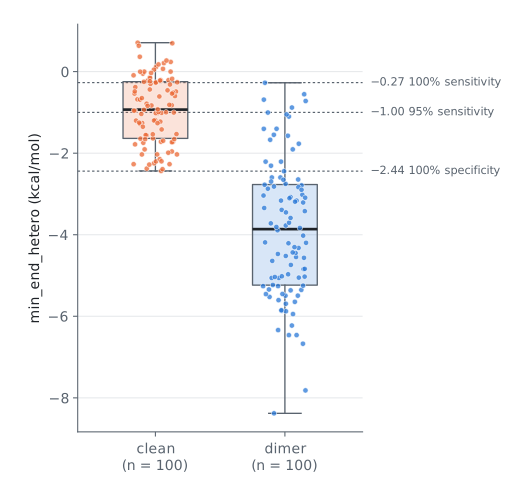
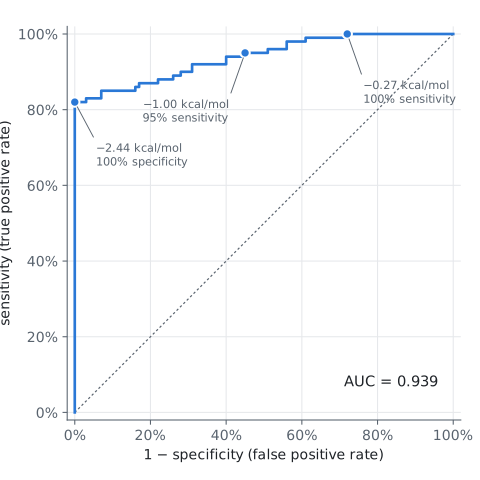
The model was calibrated on 200 RT-qPCR reactions (100 confirmed dimers, 100 clean pairs; data courtesy of Biogazelle): 250 nM of each primer, SsoAdvanced Universal SYBR Green Supermix, 45 cycles, 60 °C annealing, evaluated in no-template control (NTC) reactions. A positive NTC signal defined a dimer. Area under the ROC curve: 0.939. The primers were 16 to 28 nt long (median 20 nt); the thresholds have not been tested on longer primers, such as primers with adapter tails.

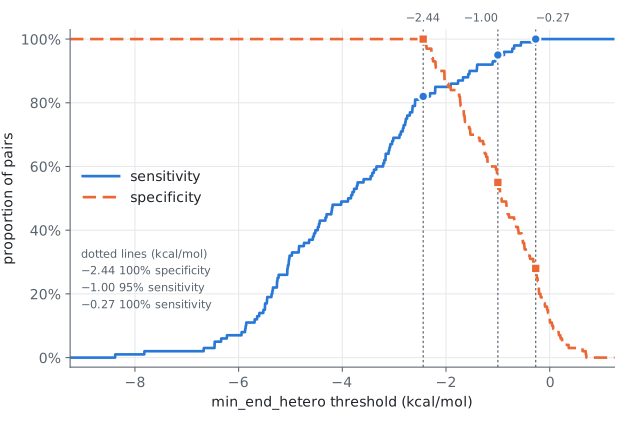
min_end_hetero thresholdcriterionsensitivityspecificity
< −2.44 kcal/mol100% specificity82%100%
< −1.00 kcal/mol95% sensitivity (default)95%55%
< −0.27 kcal/mol100% sensitivity100%28%
min_end_hetero rangerisk tierdimer rate in training data
< −2.44 kcal/molhigh risk100% (82 dimers, 0 clean)
−2.44 to −0.27 kcal/molmedium risk20% (18 dimers, 72 clean)
> −0.27 kcal/mollow risk0% (0 dimers, 28 clean)
Sensitivity and specificity as a function of the threshold
sensitivity and specificity as a function of the threshold
min_end_hetero for clean and dimer pairs
min_end_hetero for clean pairs and confirmed dimers
ROC curve
ROC curve (AUC 0.939)
alignments

Each entry shows the dominant direction first, then the other direction (one diagram for homodimers):

5'-[top strand, 5'→3']-3' [match string] 3'-[bottom strand, 3'→5' left to right]-5'

| is a Watson–Crick pair; . on a strand is a bulge (a nucleotide looping out opposite the other strand); . in the match string is a paired mismatch. Example (ΔG = −2.65 kcal/mol, high risk), with a bulged T on the top strand:

5'-CTCTATGTGTTGGAGTCAT.GAAG-3' ||| | |||| 3'- TTACTCGGAGTCTTCCTTAC-5'

The diagram is the structure Primer3 used to compute the reported ΔG, including bulges and internal loops.

input and output

Column names and a header row are optional. Sequence columns are recognized by their content, each ID as the column next to its sequence, and an outcome column as a column holding only dimer and clean. Other columns (for example notes) are ignored. Recognized column names, listed below, take precedence.

pair mode

  • four columns: left ID left sequence right ID right sequence; IDs are optional
  • recognized column names (case-insensitive) include forward_primer_name, left_primer_name, forward_primer, left_primer, the reverse_ and right_ equivalents, and outcome (or label, class, result, status)
  • missing IDs are generated as FWD_1, FWD_2, … and REV_1, REV_2, …
  • an optional outcome column holds the known result of each pair (dimer or clean, for example from no-template controls). It is not used in the calculation: the alignment report compares it with the prediction (✓ or ✗ label mismatch), and the results table repeats it next to the prediction.

multiplex mode

  • one primer per row: ID and sequence, or the sequence only (IDs P001, P002, … are generated)
  • recognized column names include primer_name, primer_id, name, id, primer_seq, sequence and seq
  • a table of primer pairs (four columns, as in pair mode) is also accepted: all primers of both sequence columns are then used
  • identical sequences are analyzed once, with the first ID; a note lists the merged duplicates (also in the alignment report)
  • N primers give N × (N − 1) / 2 heterodimers plus N homodimers

general

  • separators: tab, comma or semicolon; files: .xlsx, .csv, .tsv, .txt; lines starting with # are ignored
  • sequences may contain A, C, G and T only (case-insensitive)
  • primer length: Primer3 needs at least one of the two sequences to be 60 nt or shorter. A pair of two primers longer than 60 nt, and the self-dimer of a primer longer than 60 nt, are not computed: their ΔG values stay empty, flagged and predicted read not computed, the alignment report gives the reason, and sorting puts them last.
  • downloads: the results table (.xlsx, .tsv, .csv) and the alignment report (.txt) have the same layout as the Python script output
  • every output file states the DimerDetective version and build, for example 1.2 (build 20261102-0058): in the header of the alignment report and in a final version column of the tables. The build is the date and time (Belgian time) of the last change; the version (1.2) is the one to cite.
how to cite

DimerDetective version , Jo Vandesompele, Ghent University, https://jvdesomp.github.io/DimerDetective/

software and references

DimerDetective is open source (GPL-2.0) at github.com/jvdesomp/DimerDetective, with the Python command-line script that gives the same results.

Software versions used for the results reported here: DimerDetective 1.2 (build 20261102-1447); primer3-py 2.4.0, which includes libprimer3 release 2.6.1 (calc_end_stability and thal.c, the latter compiled unchanged for this web app); Emscripten 6.0.13 (compilation to WebAssembly); Python 3.13.5 with pandas 3.1.0 and openpyxl 3.1.5 (Python script; the automated checks also use Python 3.12); SheetJS 0.20.3 (Excel import and export); matplotlib 3.11.2 (calibration figures).

References: SantaLucia J (1998) PNAS 95:1460–1465. Untergasser A, Cutcutache I, Koressaar T, Ye J, Faircloth BC, Remm M, Rozen SG (2012) Primer3, new capabilities and interfaces. Nucleic Acids Res 40:e115.

contact

Questions, suggestions or problems? Send a message to the developer. Your message is relayed by email through Web3Forms. It contains what you enter below; Web3Forms also adds your IP address. Please note that a (quick) reply cannot be guaranteed.

privacy and usage statistics

To see how the app is used, anonymous usage statistics are counted with GoatCounter: page views, runs per mode and interaction type, the number of pairs or primers per run, and downloads. GoatCounter uses no cookies and stores no personal data; sequences, primer names and file names are never included.

Messages sent with the contact form are relayed by email through Web3Forms; they contain what you enter in the form, plus your IP address, which Web3Forms adds.